
International Women's Day: Celebrating women supporting women in sports
TRENDING
- KAT as the Wemby stopper
- Miz makes heater history
- Zverev's 1st Grand Slam title
- Play 2026 Soccer Pick 'Em
- Monaco GP takeaways
Story by Cassandra NegleyWomen's basketball reporter
Fri, Mar 8, 2019
What Women Want Now is a program by Yahoo Sports and her sister sites dedicated to creating content about the issues and stories that matter most to women. Read more here.
Balance is a pivotal part of sport. It takes physical balance to compete, from a balance beam to a winning strike. It takes balance, too, for women to continue a career and begin a family. It takes balance for them to one day receive the accolades they rightly deserve.
International Women’s Day celebrates women’s achievements in all areas of life and this year’s iteration is based on a “[#BalanceForBetter](https://www.yahoo.com/lifestyle/know-international-womens-day-march-194000916.html)” theme. How fitting for sport.
As Gloria Steinem summed it up, the battle for equality and progress is not due to one singular person, but to collective efforts. Serena Williams did not make the summit on her own. Neither did Maya Moore, Alex Morgan, Kelly Clark, A’ja Wilson, Ronda Rousey or Allyson Felix. No one.
There are women behind the scenes doing some of that climbing, promoting the sports, athletes and coaches we celebrate. They take on sports information roles, guide fan clubs and push for better representation in media. This is a look in at the women supporting women we love in sports and what they do to “Balance for Better.”
The women who promote a team from within
Diana Koval rattles off specific alumnae and their whereabouts. One made it out of the projects to be an author and Harlem Globetrotter. A few play professionally. Another is, most notably, the reigning WNBA Rookie of the Year.
Koval is a leading factor in our delightfully authentic digital interactions with head coach Dawn Staley, 2018 WNBA Rookie of the Year A’ja Wilson and fellow Gamecocks players and alumna that include Allisha Gray and Tiffany Mitchell. None of what we see is manufactured, which might be why the USA Basketball video from February 2018 is a hit among almost anyone who sees it.
“You’re in the room, you set it up and you let them go,” Koval told Yahoo Sports about her approach. “And nine times out of 10 you’re going to get some comedy gold like that USA Basketball video. It’s one of my all-time favorites.”
To quote Wilson, set to begin her second season with the Las Vegas Aces this spring, “... That’s craaazy.”
“My favorite is ‘What position will A’ja play? I see her on left bench,’” Koval said, still laughing at the indelible memory. “Those are the personalities that I get to deal with on the team. Those are the relationships that they have with coach Staley. And it’s just so natural for her.”
Koval and Staley have worked jointly for 11 years to build a following in Columbia as well as out of it. When Staley was hired, they decided they would hold regular media availability no matter if one reporter showed up or 10. Koval’s team films it either way and sends the video out on an FTP site for TV outlets to grab.
“Transformative” is the only word Koval can think of as a descriptor.
Social media “couldn’t fit more perfectly with coach Staley if it had been designed for her,” she said. And South Carolina is at the top of the women’s basketball world right now.

Diana Koval, top left, looks out at the media coverage during a news conference with head coach Dawn Staley (Provided by Diana Koval/South Carolina athletics)
Media outlets, the historic gatekeepers of information, show up when a team is winning and putting fans in the stands. That’s what slowly happened at South Carolina. But even winning isn’t always a guarantee and it falls on those in the organization to carry the load. Women’s sports comprise approximately 3.2 percent of TV sports coverage, per a recent study published by Nieman Reports. The article gave ways to improve it and used the Minneapolis market as an example, though it’s far from perfect.
Minnesota Lynx general manager and head coach Cheryl Reeve spoke with Richard Deitsch of The Athletic last year about a lack of coverage. The Lynx won four WNBA titles in seven years, a seldom-discussed dynasty, and average 10,000 fans a game. The coverage was still lacking so she sat down with the local media and asked what could be done to “help us help you.”
“We’ve really tried to work within all of those parameters that are given to make ourselves as accessible as possible,” Reeve said. “We say no to nothing. And that’s kind of our philosophy. And I shared that with our players in training camp. We say no to nothing. There’s nothing too small, too big, too whatever. This is all very important. So I know that the access is there.”
Reeve’s interview is worth the listen to understand how far women (and certainly men in those positions) must go to support female athletes. She touched on what she sees as her responsibility to do media outreach, despite male counterparts not having to do it, and how shallow the media dives when it does cover women’s sports. Greater exposure, both she and Deitsch said with different examples, is crucial to changing minds no matter the subject.
There are hundreds of women pushing to get their teams covered around the country. There are also hundreds of men. They range from high school coaches to collegiate sports information directors to professional league general managers. In many instances they work harder to find the same result.
“I do think there’s something powerful in the demonstration of women supporting women,” Koval said. “I treat coach Staley as I would any of my coaches, but I do feel like there’s an added bonus of me being able to say ‘Women have a variety of roles in athletics and they’re all valuable and important. And whatever you aspire to, you can still achieve that no matter what your gender is.’”
The women who build a following
When it comes to filling an arena, stadium or rink it takes more than well-timed tweets and bountiful personalities. It takes a formal or informal squad of people who build excitement, fandoms and energy.
Shannon Desrosiers and Britni Smith are women supporting girls supporting women we love in sports, but that’s too much of a mouthful. It’s also not all-encompassing of what they do in Potsdam, New York, for the two-time reigning NCAA National Champion women’s hockey team.
Desrosiers coached the Clarkson Golden Knights to their first title in 2014 alongside her husband, Matt, before stepping out of the role. Smith joined as assistant coach a few years ago and Clarkson won back-to-back titles in 2017 and 2018.
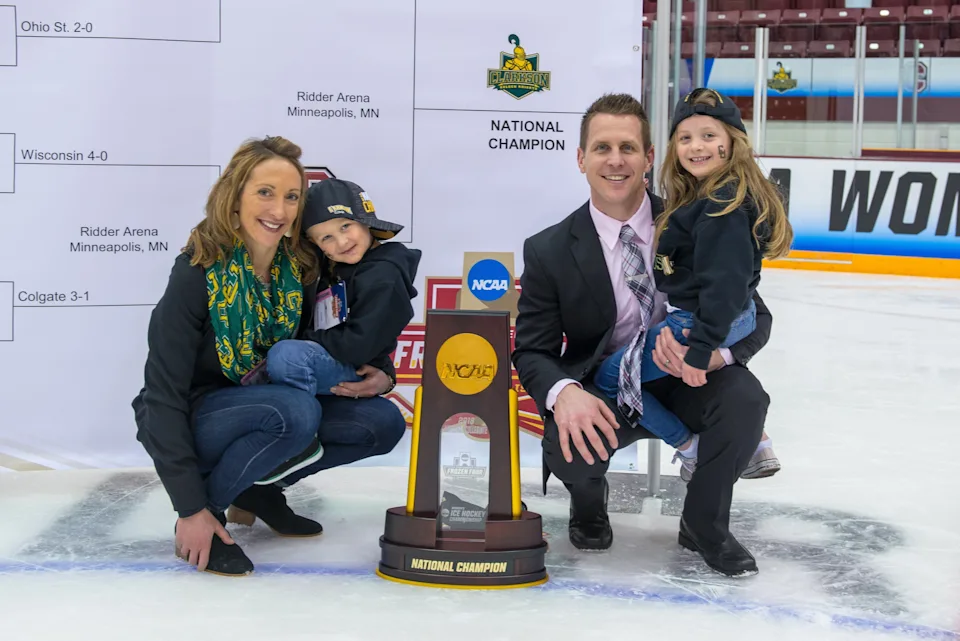
Shannon Desrosiers, husband Matt Desrosiers and their two children pose with Clarkson's national championship trophy. (Provided by Desrosiers)
They were the first team to win a title outside of the Western Collegiate Hockey Association (WCHA), where the majority of teams are in the “State of Hockey.”
Good ole’ Minnesota, a state to aspire to when it comes to balance. The University of Minnesota women’s hockey team and its volleyball team are among the nation’s best in attendance, the Lynx bring in thousands and the former semi-pro Minnesota Whitecaps are hitting new heights in the National Women’s Hockey League (NWHL). The team locked in the No. 1 seed in the playoffs its inaugural season and sold out every game in advance — box offices were never even set up at the arena. Their first-ever playoff game sold out in 25 hours, per the team.
NWHL founder and commissioner Dani Rylan noted the state’s support in a story by Pat Borzi for espnW last month.
"I was sitting [there] thinking, is everybody here talking about women's professional basketball?" Rylan said. "How amazing. How women's sports are perceived in Minnesota is maybe different than in the [rest of the] world. They look at their athletes as high-profile athletes, period, regardless of gender. It was nice and refreshing to hear, and definitely influenced the decision to move out there as well."
Back east in a North Country of a different kind, Desrosiers and Smith help lead a fan program that has created its own boost for high-profile athletes at Clarkson University.
The women who push for representation
One can choose to follow these social accounts, read the stories, view the videos, subscribe to newsletters and attend games. Or one can choose not to.
It’s when large corporations take on the cause that the word spreads wide.
The Super Bowl featured multiple brands showcasing female empowerment with commercials ranging from Toyota’s spot with collegiate safety Toni Harris to Serena Williams promoting Bumble in a spot led by a team comprised entirely of women. It shifted a little closer toward a 50-50 balance of representation in ads to match the viewership split.
The NFL included 15-year-old viral sensation Sam Gordon in its 100th anniversary commercial. The NHL agreed to allow the speedy Kendall Coyne Schofield, on the suggestion of Nathan MacKinnon, participate in its All-Star fastest skater competition.
And Nike launched its “Dream Crazier” campaign late last month, debuting the commercial during the Academy Awards. Serena Williams, Chloe Kim and Simone Biles show women’s transformation from hearing the negative statements thrown at them to using it as motivation.
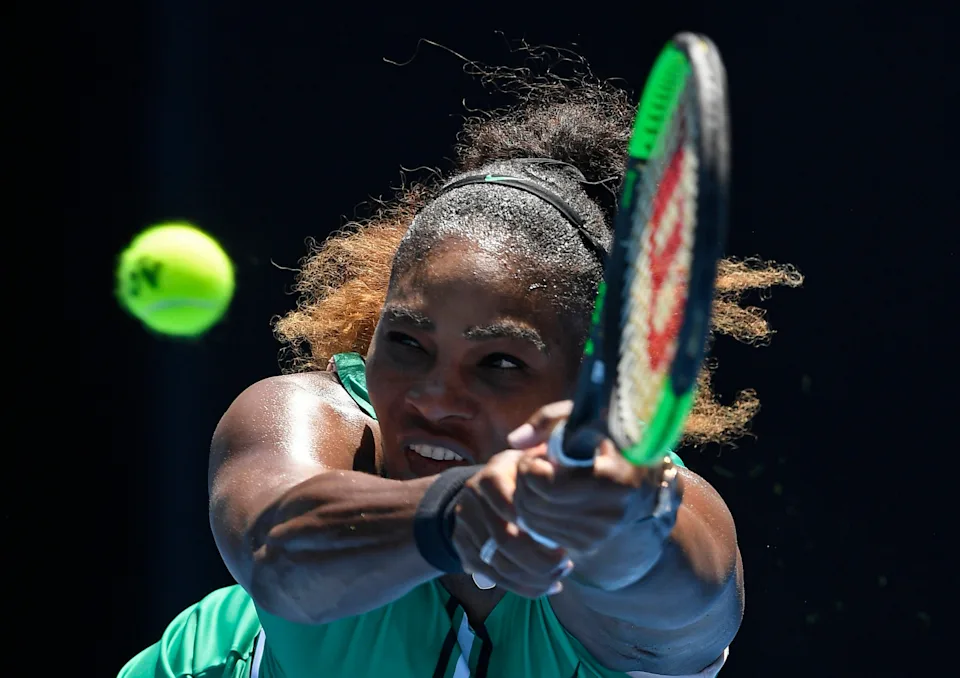
Serena Williams narrated Nike's latest female empowerment commercial. (AP Photo/Andy Brownbill)
Nike’s campaign is first and foremost to sell merchandise and the women’s athletic market is a hot one. The company is also finding ways to better support women in their quest to compete, from performance hijabs to better fitting sports bras.
“We want everyone to participate in sport — and not just every now and then but regularly — and we know that to support the dream we have to lead a conversation regarding a variety of desires and needs,” Rosemary St. Clair, vice president and general manager of Nike Women, said in an article on the company’s site shortly before the debut.
It can’t be overlooked, though, that all of this furthers support of women athletes and by extension coaches, trainers, fans and executives, many of whom are women themselves.
It’s exposure. It’s being what you can see. It is women supporting women we love in sports whether it be through a story, a video, a tweet, a group trip to the championships or an advertisement forcing us to think about how far we’ve come but how far there is to go.
It is women working toward a better balance.
What you can do this weekend
What you can do this weekend
Support the women we love in sports by attending their games, watching the match-ups and following them on social.
South Carolina (21-8, 13-3 SEC) will play in the SEC tournament quarterfinal Friday night. It could end up a thrilling rematch in the title game against Mississippi State. The quarterfinal is on SEC Network, the semifinals are on ESPNU and the championship airs on ESPN2. Selection Monday is March 18.
The NWHL Isobel Cup semifinals are Saturday and Sunday with the Minnesota Whitecaps hosting on the latter. All playoff games stream on Twitter.
The ECAC women’s hockey championship will take place at Cornell’s campus this weekend. Cornell hosts Princeton and Clarkson will play Colgate in Saturday’s semifinals. All games are on ESPN+.